A Risk-Prioritized Patch Queue Belongs in Email Safety
CISA added two actively exploited vulnerabilities to its Known Exploited Vulnerabilities catalog on July 27, 2026. Why email safety includes a risk-prioritized patch queue, not only message inspection.
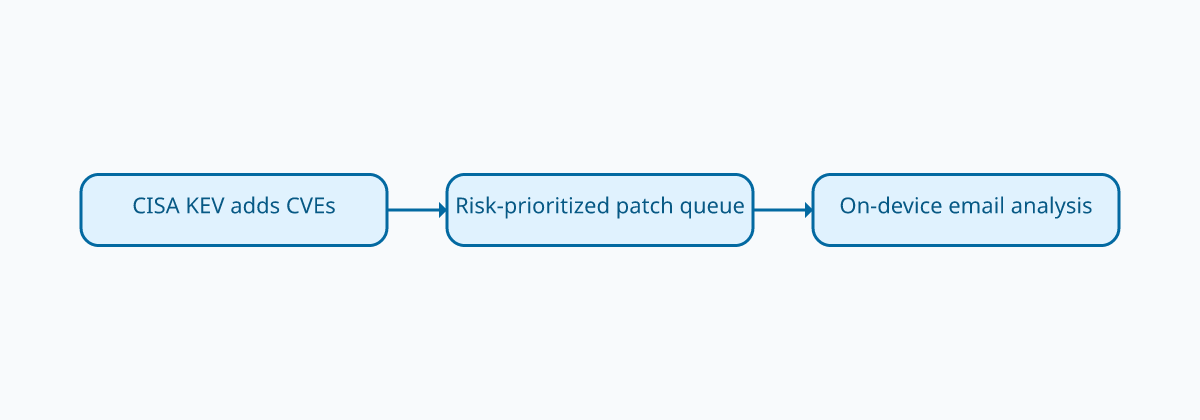
On July 27, 2026, the Cybersecurity and Infrastructure Security Agency added two new entries to its Known Exploited Vulnerabilities (KEV) catalog: CVE-2025-68686, affecting Fortinet FortiOS, and CVE-2026-16812, affecting the Arista VeloCloud Orchestrator. Both were added based on evidence of active exploitation, not theoretical risk. CISA's alert encourages all organizations to adopt risk-based vulnerability management and references Binding Operational Directive 26-04, which sets remediation deadlines for federal civilian executive branch agencies.
That announcement is not, on its face, an email story. Neither CVE describes a mail-server flaw. But it is a useful prompt to separate two questions that email safety often conflates: "Does this message look deceptive?" and "Can the software that displays or routes this message be exploited?" A complete answer needs both, and the second one is exactly what a patch queue addresses.
What the KEV Catalog Actually Does
The KEV catalog is a prioritization list, not a scanner. When CISA adds a CVE, it is asserting that someone is already exploiting the vulnerability in the wild and that remediation should outrank the long tail of lower-risk patches. For FCEB agencies, BOD 26-04 binds that prioritization to a deadline. For everyone else, CISA's language is an encouragement, not a mandate — but the underlying logic transfers: when exploitation is confirmed, the patch stops being optional hygiene and becomes a time-sensitive control.
The two July 27 additions illustrate the range of surfaces a patch queue must cover. CVE-2025-68686 sits in FortiOS, the operating system behind Fortinet's network security appliances — infrastructure that often inspects or gates the very traffic email traverses. CVE-2026-16812 sits in the Arista VeloCloud Orchestrator, a management plane for wide-area networks. Neither is a mailbox, yet both can shape whether mail reaches a user safely or whether an attacker can move laterally once inside.
Why Patching Is Adjacent to Email Safety
Email safety is often taught as a content problem: read the sender, inspect the link, watch for urgency language. Those habits still matter, and on-device analysis can help a person reason about them privately. But a message can also be dangerous because of what vulnerable software does while rendering or routing it — a theme CISA has reinforced across several 2026 advisories. A cross-site scripting flaw in a webmail client, a privilege escalation in a mail gateway, or a remote code execution bug in a network appliance can each turn an otherwise ordinary message into an entry point.
This is why a risk-prioritized patch queue belongs in the same conversation as message inspection, even though the two controls are owned by different people. Patching is organizational security hygiene. It is not something an email analysis app performs, and it is not something Veilsort performs. It is the responsibility of the administrators who run the mail servers, network appliances, and endpoints that touch a message before a person ever reads it.
Scope note: Veilsort analyzes the content of a suspicious email on your device. It does not patch, update, harden, or monitor the systems listed in the KEV catalog. Patching is an adjacent organizational control, not a Veilsort capability.
What Veilsort Actually Does
Veilsort is a privacy-first email analysis tool for iOS. A user shares or pastes a suspicious email — a scam, a phishing attempt, an unclear payment request, a legal demand — and Veilsort analyzes it fully on-device using Apple Foundation Models. The app returns a plain-English summary, risk flags, extracted deadlines, and a cautious suggested reply. The email content never leaves the device.
That boundary is deliberate and it is narrow. Veilsort makes zero outbound network requests, bundles zero third-party SDKs, and collects zero telemetry beyond MetricKit diagnostics. It does not access email accounts, sync inboxes, or integrate with IMAP or POP3. It does not analyze attachments or images in v1.0, and it does not batch-analyze multiple messages. It is a decision-support layer for the human-facing side of one message at a time.
None of that replaces a patch queue. A content analysis tool can flag a deceptive request; it cannot close a remote code execution hole in the appliance that delivered the request. Conflating the two would overstate what on-device analysis can do and, worse, imply that reading an email carefully is a substitute for patching the software that rendered it.
How the Two Layers Compose
The honest model is layered, not competitive. A risk-prioritized patch queue reduces the chance that a message exploits the software around it. On-device content analysis helps a person judge whether the message itself is asking for something dangerous. The two controls answer different questions, are owned by different actors, and fail in different ways — which is exactly why both belong in an email safety practice.
For individuals, the practical split is straightforward. Keep browsers, mail apps, and operating systems current so that rendering and routing software is not a known-exploited surface. Then, for messages that survive a patched environment and still feel off, use a private analysis step that does not introduce a new exposure of its own. The goal is not to pick one layer; it is to avoid pretending any single layer is sufficient.
For administrators, the July 27 KEV additions are a concrete reminder to check whether FortiOS and VeloCloud Orchestrator instances are current and to treat confirmed-exploited CVEs as deadline-driven, not backlog, work. CISA's encouragement to adopt risk-based vulnerability management applies beyond federal agencies — any organization that routes mail through appliances it does not directly control should know which of those appliances appear in KEV and why.
Reading the Catalog Honestly
One risk in writing about KEV is implying that the catalog itself is a defense. It is not. KEV is a list of known-exploited CVEs with remediation context; it does not scan, patch, or alert. Treating it as a feed to triage is reasonable. Treating it as a substitute for patch execution is not. The same honesty applies on the analysis side: a tool that summarizes a suspicious email is useful precisely because it stays within its boundary, not because it claims to cover the whole threat surface.
The July 27 additions are a small, specific signal — two CVEs, both actively exploited, both in infrastructure that can sit near mail. The broader lesson is structural: email safety is not only message inspection, and a risk-prioritized patch queue is the adjacent control that keeps the software layer from becoming the weak link.