Open Source Trust Needs a Lifecycle
CISA's new guidance treats open source security as a lifecycle practice. The practical record connects what a product uses, how findings are handled, and what evidence accompanies a release.
On July 30, 2026, the Cybersecurity and Infrastructure Security Agency published Open Source Software: Security Principles and Practices. CISA says open source software is embedded across modern systems and describes guidance for agencies that use, evaluate, or publish it. The publication covers risk management across the full lifecycle and points to trust assessment, vulnerability management, software bills of materials, secure development, and open source artificial intelligence systems.
The useful phrase is "full lifecycle." Open source trust is often reduced to a decision made when a dependency is first selected: popular project, active maintainers, acceptable license, install it. That review matters, but it expires quickly. Versions change, maintainers change, vulnerabilities appear, and a dependency that was reasonable at adoption can become a different risk at release.
Inventory Is the Beginning of the Record
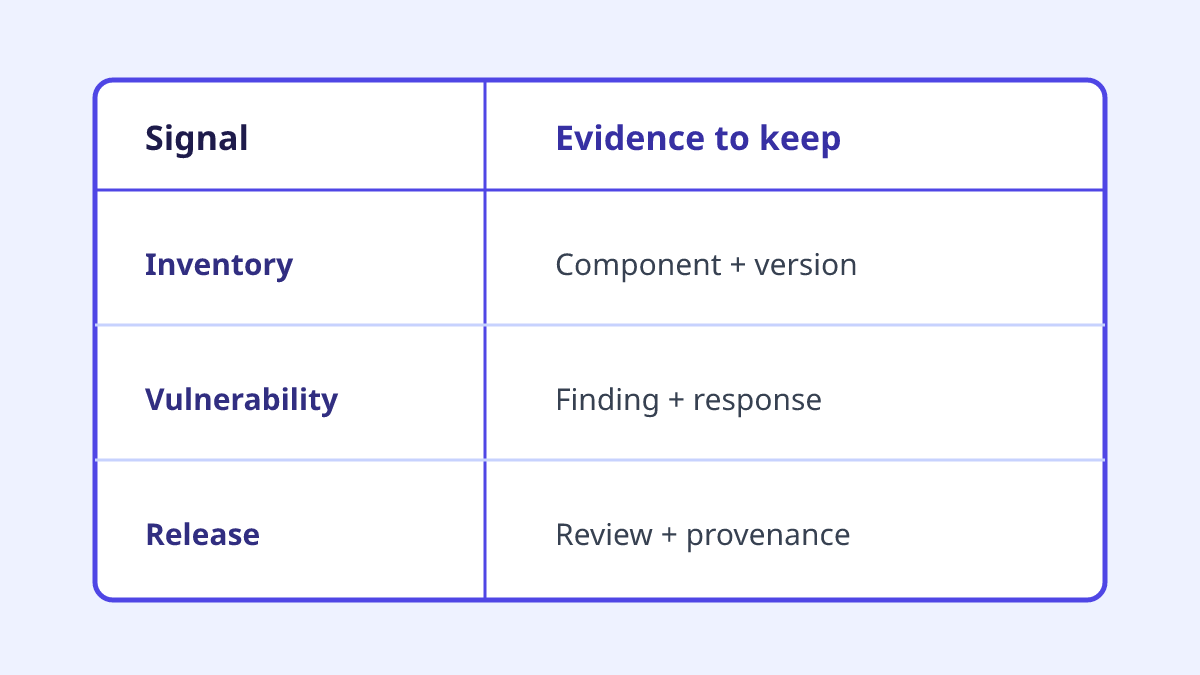
A team cannot evaluate what it cannot name. The first durable artifact is an inventory that identifies the component, exact version, source, license, and where it enters the product. A software bill of materials can provide that structure, but its value depends on accuracy. A stale inventory is not evidence of the current build.
For a privacy-focused email tool, this matters beyond conventional server dependencies. An iOS app may include packages, build tools, model resources, and engine code that never make a network request but still affect the security of the shipped binary. "On-device" describes where analysis runs; it does not make the software supply chain disappear.
Vulnerability Response Needs Ownership
CISA's publication explicitly includes vulnerability management. The operational question is not merely whether a scanner can produce a finding. It is whether someone can connect that finding to the inventory, determine whether the affected code is reachable, record the response, and verify the updated build.
A useful finding record includes the affected component and version, the advisory or source, the product surface that may be exposed, the owner, the decision, and the evidence that closes the finding. Closure might mean an upgrade, removal, configuration change, or a documented conclusion that the vulnerable path is not present. The important part is that the conclusion can be reviewed later.
Lifecycle rule: Every dependency decision should be answerable at three moments: why it entered, how new findings are handled, and what release evidence proves the current version is acceptable.
Release Review Is Different From Adoption Review
A project can pass an adoption review and still fail a release review. The component selected six months ago may no longer be current. The lockfile may not match the inventory. A transitive dependency may have appeared without a direct decision. Release review asks about the exact artifact being shipped, not the remembered architecture.
This is why provenance belongs beside the release. Teams should be able to trace the built artifact to its source revision and dependency state. They should also preserve the validation results that mattered for that release. A list of tools that ran is weaker than a receipt showing what they examined and whether they passed.
Trust Assessment Is Not a Popularity Contest
CISA says the guidance introduces a C4 Framework for trust assessment. Without substituting a blog summary for the publication, the broader point is clear: trust requires a method. Stars, download counts, and familiar names can be useful leads, but none proves that a particular version is suitable for a particular product.
A method asks narrower questions. Is the source identifiable? Are releases and security updates maintained? Is the license compatible? Can the team reproduce or verify the artifact? Does the dependency add network behavior, telemetry, or sensitive-data handling? What happens if maintenance stops? The answers vary by product, so the record must include the product context.
What This Means for Email Safety
Email analysis deals with adversarial content. That makes dependency boundaries especially important: parsers, rendering code, imported data formats, and model inputs all process material an attacker may influence. A lifecycle record helps the team distinguish a content-level risk from a software-supply-chain risk and assign each to the right control.
Veilsort's role remains narrow. It analyzes a suspicious message on the device and returns decision support. It does not certify open source projects, produce an organizational SBOM, or manage another system's vulnerabilities. The product lesson is internal: a privacy claim is stronger when the shipped dependency set, network boundary, and release evidence remain reviewable together.
A Practical Trust Checklist
- Inventory every direct and transitive component in the release artifact.
- Record exact versions, sources, licenses, and product entry points.
- Assign an owner for vulnerability findings and preserve the disposition.
- Review network, telemetry, and sensitive-data behavior when dependencies change.
- Bind release validation to the source revision and dependency state it examined.
- Define a replacement or containment path for abandoned critical components.
CISA's new publication is a reminder that open source security is not a one-time approval. Trust is a maintained record. When inventory, findings, and release evidence stay connected, teams can make that record concrete enough to inspect instead of relying on reputation or memory.